Monday, June 30, 2014

New Memories!


Hey guys!

Today was certainly a day to remember!

In the morning Kilian and I met up with Lina and Paula for breakfast. I introduced Kilian and we all got along really well. Shortly after that, Kilian and I went to Cecilia's office for a quick rundown on the rules, the same rundown I got when I first arrived. Cecilia wasn't there so her assistant, a kind man whose name I've forgotten, gave us the speech. I was there to make sure Kilian understood the rules and found out what week he had to clean the bathrooms, which shower he needed to use, etc. The meeting went well and I can say that I understood all of it. There were a few parts that Kilian needed clarification on, but other than that he did really well (much better than I originally did).

After getting Kilian's appointment sorted out we went looking for Sofia since she had a meeting with Kilian after Cecilia's. We went to Sofia's office and saw that it was closed we realized that we were supposed to meet Sofia in the same building Cecilia's office is. So we basically went a quarter of the way across campus only to realize that we needed to go back. Once we got back to Cecilia's building, her assistant explained to us that Sofia wouldn't be able to meet with Kilian at 1, but Arnoldo (aka Pops) would be able to meet him at Aromas coffee shop which is under the library. So we went to the library, Kilian sat and waited for Arnoldo, and I headed off for a meeting with Profe Moro.

That meeting was really interesting and had a lot of information in it, so I'm going to dedicate tomorrow's post to our discussions.

Once I finished my meeting I went back to Aromas to see how Kilian and Arnoldo were doing. They were just finishing their conversation when I showed up and we started talking about yesterday's historic win, the beach, and other things. Arnoldo was going to bring Kilian to the organic farm, la finca organica, which is also known as the FIO. Since I didn't see it yet, I tagged along with them.

This farm is amazing. It's really far up campus, about a mile or more away from the library. Arnoldo explained to me that there was a bus that picked students up and drove them to the farm so they wouldn't have to walk the whole way. Once we pulled into the camp we went to Arnoldo's office. He's the manager of the farm which is pretty cool considering that he's only 33 (but that's a lot older than us so Marianna started calling him Pops). He explained to us that the 2 buildings next to his office were houses where professors and researchers can stay while studying at the farm. Apparently these houses can hold up to 16 people! Once Arnoldo got his boots from his office, he led us across the street to the Cacao area (Note: It's not pronounced Cocoa. It's pronounced Ka-Cow).
Entrance to the farm

A cacao tree
This area was a project that was originally started by a student here at EARTH. Arnoldo explained that years ago there was a shortage of cacao plants due to destructive insects that would eat the plant. Eventually someone bred a cacao tree that was resistant to these bugs, a student at EARTH introduced them to the organic farm, and started this farm. There were also plantain trees in the same area because cacao trees take a while to produce pods and plantain trees mature and produce fruit at a younger age.
Arnoldo (left) and Kilian (right) talking about the cacao farm
Once we walked through the cacao area, we went back across the road and started to look at more of the farm. One part of the farm that I really liked was this area with a duck pond. This area was a big circle with smaller circles within it and a pond in the center. Arnoldo explained to us that this system of farming was a smart way for subsistance farmers to run a farm. The duck pond is an area for farmers to raise ducks for meat or eggs. In the inner ring that was a foot or so from the pond you plant the vegetables that you're going to eat the most, such as rice, beans, corn, and other important crops. This allows the farmer to keep these crops for themselves. The next ring is for cash crops that the farmer plans to sell, such as cacao, pineapples, bananas, plantains, corn, and whatever popular crops sell well in the country. The outer ring is a mixture of crops that the farmer needs to sell and crops that they could use for food. This system is really great because this gives the farmer plenty of option to diversify the crops, make money in a reasonable way, all while maintaining a good food supply for the farmer's family.
Not many people know that pineapples are grown from a bush, not a tree. The more you know!

The gate to the duck pond

Ducky! If you look towards the fence you can see the inner ring

Then we went to my favorite part of the farm. The animal areas! The animal farm that I work on doesn't have chickens. On the FIO there are 450 or so free range chickens that are used for laying eggs (and possibly meat production, but I can't remember). These eggs are used in the cafeteria and are served for breakfast every wednesday morning. Guess what I'm eating tomorrow! When we passed by the chickens they were in their coop. Arnoldo pointed out that they were in their coop because some of the farm workers were cutting down the grass in the area around them. Arnoldo explained that they'd usually be outside, but for the next few hours they'd be in their coop (which was huge I might add) for their own safety.
A shot of the chicken coop
Past that, we saw the pasture and pen area for the horse and cows. The FIO doesn't have as many animals as the animal farm does, so their pasture is very small and their pen area isn't as big as the pens on the animal farm. The most interesting thing about this pen area was that it was made out of wood and the planks had tires on them. I was really confused at first, but then Arnoldo explained that these recycled tires make the area more comfortable for the livestock and that rubbing up against the tires won't hurt them as much as rubbing up against the wood would. He also explained that the pen had been there for about 10, 20 years or so. It was in really good shape! A few paint jobs and the occasional new plank really made it look new. THe pasture however wasn't looking too hot. Arnoldo pointed out some brown spots in the pasture that indicated that there wasn't enough grass for the animals to graze. Recently they have been harvesting sugar cane and other plants to feed to the animals, but Arnoldo and the other workers want the pasture to recover quickly so that the animals are back on their usual diet. Further back on the farm there is an area for pigs. After working on the pig farm this farm was peaceful and didn't smell nearly as bad. It didn't have a smell at all! The pigs were covered in mud and as happy as can be. There were 3 or 4 pregnant sows that we saw who were really close to their due date. They were so quiet and calm. I even pet one!

When you walk out of the pig area there's a big composting area on your way back to the farm. We actually walked past it on the way to the pigs and stopped there on our way back. Here there is a lot of projects dedicated to compost and decomposing microorganisms. This area seemed to be Arnoldo's favorite. He's really passionate about what he does here at EARTH and it really shows when his faces lights up at the word "microorganism". There were 3 big compost boxes that were filled with different plant material. The box on the right has cacao shells in it, the middle has pineapple leaves and whatever else is left of the pineapple plant, and the left has corn leaves and stalks. Arnoldo went through each of these compost boxes with us and explained why each of them were separated, why they should be composted, and other really important information.
The 3 compost bins
Pops talking to us about the Cacao compost

Arnoldo explaining how the tank at the bottom of the box collects any water that flows through it, thus preserving the nutrients that would've been lost through runoff. 

The pineapple compost
The compost pile I remember the most is the pineapple one. Arnoldo explained to us that there used to be, and in some places there still is, a problem with pineapple waste. Farmers would take their tractors, bulldoze the dead pineapple plants, and push them into a river. The river water didn't decompose the plants, it actually caused the plants to rot in the water. Rotting is different than decomposing because rotting releases more bad things whereas decomposing releases good nutrients. The rotting pineapple plants would harm the water system and attract flies to nearby livestock farms where they bite cows, lay eggs in the wounds, and ruin the meat. The government eventually stepped in and told farmers that they needed to do something. Some farmers have started to compost the leftover pineapple leaves the same way that they do at the FIO. It was interesting to hear how plant waste could make such a big problem.

In addition to the compost piles there were these big blue barrels filled with microorganisms that were used to break down animal feces, break down dead plants, kill any bad pests, and so much more. These barrels had this strong smelling, fermented liquid that held all the microorganisms in. Arnoldo loved talking about the microorganisms and I completely understand why! They have so many beneficial uses!

Once our tour was done, Arnoldo, Kilian, and I went back to campus for lunch with Marianna, Lina, and Paula.

Fast forward to 8:00 at night. Today was Lina's birthday and Marriana and Paula bought a cake and planned a surprise party! I just found out about it after dinner and Kilian and I were told to distract her. I think our epic ping pong matches that lasted for an hour or so kept her busy while Marianna and Paula got the cake together, told people about it, and put on music. I left our ping pong session early because I was "sick" and tried to see if I could do anything to help set up for the surprise. As we waited for Lina to arrive at 8:30 I started talking to some students that I never met before. I met one guy who was from Lebanon! He told me all about how he might go back to Lebanon for an internship, or go out to California for an internship at a vineyard. When 8:30 came around, Paula and Kilian brought Lina to the party! It was so nice. We sang "Happy Birthday" to her in 3 languages ( Spanish, Lebanese (I think), and a language I didn't recognize at all). The cake was really good, Lina was happy, and I hope she had a great birthday!
Lina's cake

Marianna walking with the cake towards Lina

Lina blowing out the candles

The intern squad: Kilian, Paula, Marianna, Lina, and I
It was a great day filled with good memories! 

Goodnight guys!

-Allie


Sunday, June 29, 2014

Victory!

Hey guys!

So, how about that Costa Rica game? Ok I'll get back to that later, there were more important things that happened today!

So I got to sleep in today and it was great. I went up for breakfast around 8 and stood outside the cafeteria to wait for the new intern from the USA named Kilian. I was told to meet him by the schedule board but after standing there for a while I assumed that I missed him. I wrote a note explaining that I missed him and put my email there for him to contact me. I went to eat breakfast and I was so happy when I saw that pancakes were an option! It was interesting because the syrup they have here is very bitter in comparison to syrup in the US. The US food here is different that the food at home, but if it's remotely similar to food from home I'll try a little bit.

After breakfast I went back to my room to work on a project I have for my spanish class. I think I'm doing well with it! I have to explain everything that's on the farm and explain some of the systems, all in spanish. It's a little difficult, but I'm working on it and I think it's coming out pretty well.

The farm has a lot of different parts to it and it is all integrated together. Everything has a use and it is so much better for the environment.

One example is our biogas system. We have these big biodigestors that produce electricity for the farm and gives us methane for the outdoor kitchen. Biodigestors are these big plastic bags that are filled with animal feces. We use the pig and cow feces for fuel!
Here's a video that explains biodigestors a lot better:


We also have a compost system that uses any animal feces we don't put in the biodigestor.When it comes to liquid waste, we have these vents on the ground that we hose some waste into. These vents drain the liquid into a small lagoon next to the farm, where the waste would be used as fertilizer for the aquatic plants.

Another example is the diet of the animals here on the farm. We feed these animals leftovers from the cafeteria. Cows are fed a mixture of sugarcane, minerals, and chopped up pineapple that the cafeteria didn't have a use for. Pigs are fed minerals and a mix of fruits and vegetables from the cafeteria. This is a great way to get rid of food waste in a responsible and useful way.

These are a few points that I have in my presentation. It's really cool how this farm uses everything!

After working on this project for a little bit I went to eat lunch. Soon after I finished I found Kilian! Kilian is an intern from Colorado who studies Environmental Sciences. He came to EARTH as an intern to learn about sustainable farming practices. Kilian knew about the university because his grandfather helped create EARTH way back when. I took him around the campus and gave him a quick rundown of the things that go on here. It was really nice to talk to someone who spoke english too and understood the culture shock I experienced when I first arrived. We found out that we were both involved in Future Farmers of America in high school! He was his chapter's president and we talked a little bit about how FFA is more popular out west than it is in New Jersey. After taking a quick lap around the main part of campus we went to the game room to watch Costa Rica play against Greece.

What a game! When Costa Rica got it's first goal the room went crazy! Everyone was so excited at the possibility of Costa Rica going to the quarter finals. That hope faded a little when Greece came back with a goal. We were tied and we had to go into 2 elimination rounds. For the first round, we had to play 2 extra 15 minute halves. Both teams were doing great and once the second 15 minute half ended there was still a tie. The second and last elimination round was a shoot out. I have never been more anxious about a soccer game in my life. It felt like it was dragging on and it seemed as if we might not win. Luckily, Navas (the goalie and pretty much the savior of the team) blocked one of Greece's shots during the shoot out! Costa Rica has made history today as our team goes into the quarter finals! People were chanting, an air-horn was blowing, and it was all really exciting. I hope we make it to semi-finals!

It was a really nice day and the game was the best thing about it. I'm really excited for this week to start. This weekend the multi-cultural festival "Feria EARTH" is happening and i'm really looking forward to that. Each country has to make a dish, so I'm thinking about making chocolate chip cookies. Marianna, Kilian, and I are going to work that out soon.

Here's to a great start to what will hopefully be a great week!

Good night guys!
-Allie
P.S: I gave up on the whole vlogging thing. I don't have enough time. Sorry!

Saturday, June 28, 2014

New territory


Hey guys!

It was a really interesting work day today!

I was running late so I jumped on my bike and rushed to the farm. I got there at 6:36 but nobody really seemed to mind. I still need to work on my timing, I'll figure it out eventually. Anyway!

New students are working on the farm so Profe Moro introduce all of the 4th year students and I. Profe Moro explained my two projects (because it's hard for me to explain genetics in spanish) and all of the older students explained their projects. Once everyone was introduced, the new students took a tour of the farm while the 4th years and I got to work.

I was working in the lecheria again and it was great. I've finally gotten the hang of milking a cow by hand although there's always the occasional cow that is a little harder to milk. We went through that pretty quickly which was nice. The system is easy to learn and we only did one thing out of the ordinary. Jenny and I fed certain cows a small bucket of sugarcane mixed with mineral powder and a liquid solution. We do this every time Jenny is working on the farm to see how this diet change could make the milk better. We even had some time to talk and joke around. Jenny, Dona Yamy, and Don Maurice were joking around with me about an incident that was, to be fair, extremely funny. I didn't remember to tell you guys this story, but when I worked on the lecheria thursday a little bit of a water war went on between Dona Yamy and Don Maurice. Don was hosing down one of the milking apparatuses and accidentally squirted Dona, who responded with a quick squirt to the face. Within seconds they both turned to me, hoses in hand, and grinned. I usually don't mind getting wet, but the water was really cold. I yelled "No no no!" which stopped them from squirting me. They were laughing so hard that they forgot to squirt me. Dona Yamy and Don Maurice were telling Jenny this story, complete with an impersonation of my shrill shriek of "No no no!" Anyway, we got done milking around 9:30 and began to clean up some of the corral.

After 15 minutes or so of hosing down the area, Profe Moro and Jenny took me around the grazing system. We herded the cattle out to the designated area, ducking under electric fences (that weren't on thank god), stepping in mud puddles, wading through tall grass, and jumped over some small ditches. This grazing area is huge! There's so many sections that are going to be used and it's just amazing to see all of this land cut up into pieces, it's so organized. Once we herded the cattle into the right plot, we went back to the main farm to turn on the electric fence. I learned that you could listen to hear if the fence is turned on, or, you can touch it with a stick. I'm going to do this test every time I go out into the field, because god knows I'll find a way to electrocute myself if I don't double check.

We went up to the outdoor kitchen for a break when Jenny and Profe Moro told me that I'd be going to the lab with Jenny to test milk samples. I was so excited! The only thing I wasn't excited about was riding my bike to the lab. Jenny rode with Profe Moro in his car and I followed behind them. Let me tell you, that was one heck of a bike ride. I rode up hills, drove through potholes, did my best to avoid hitting any big rocks in the road, for about a mile and a half. I was exhausted and it was hot out. When I finally caught up with them I was really excited to get to work. Jenny told me about her project and led me into the lab, which was air conditioned to the point where I was shivering. I think that was the best thing about the lab. Anyway, the lab is really cool. It's a room off of this warehouse like building where students cook, make yogurt, and conduct food science research. In the lab itself there was some packaged herbs that EARTH sells. It was a small room, bu there was a lot of really cool lab equipment.

The sterilization chamber

The herbs
Jenny and I had to wear lab coats and hairnets throughout the entire experiment. I felt so official! The lab coat even had EARTH's logo on the pocket.

Ready to experiment!
For Jenny's experiment, she took milk samples from a lot of different cows. She was trying to prove that cows that are treated a certain way and eat a certain diet produce better milk. We used some of the milk samples she collected to measure the ph level, protein content, and amount of grass particles in the sample.

Some of the milk samples that we brought from the farm
We used a machine that calculated all of the percentages of protein and printed out the results.
The machine we used
We poured a small amount of milk into the black cup and sipped the metal rod into the cup. Within a few minutes we got a receipt breaking down the important information we were looking for.


The receipts here have the percentage of grass particles in the milk and the protein underlined because these are the big factors that make milk good. A grass percentage that's around 4 is extremely good. The receipts above have grass percentages of 4.44 and 4.54, so these samples were really good. The protein levels were exceptional as well because anything about a 3 is really good.

In addition to that test, I got to measure the ph of the samples using a pipette, a flask, some chemicals that turned the milk a slight pink when it had a good ph, and some light. I had to pour in small increments of this chemical into the milk until it turned light pink in order to show that the milk had a good ph level. Everything had to be very precise so I had to re-start a few times. I eventually got the hang of it. It was really interesting to see how certain small changes to a cow's life such as a special meal every wednesday and saturday could affect the milk so well.


It was great experience and I can't wait to go back again!

Once we were done with the experiment I helped clean up and then headed off to lunch. The rest of the day was pretty relaxing. Tomorrow I'm going to show a new intern from the US around! I'm really excited to help out. 

Bye guys!

-Allie

Friday, June 27, 2014

Friday numero dos!

Hey guys!

This is my second Friday here at EARTH and interesting things tend to happen on Fridays.

I woke up at my normal time and headed to the cafeteria for breakfast where I had some more pico de gallo, which (surprisingly) doesn't get old. I left a little bit later and arrived to the Finca Pecuaria ( the animal farm) around 6:35. Punctuality isn't an overly stressed thing here in Latin America, so being a few minutes late is normal.

Today I didn't milk but I did help by keeping records of what cows we milked and how many kilograms of milk they've produced. Each cow has an identification number that is either on an ear tag that they wear or one that is tattooed on them. Some numbers are 2100, 4680, and 4100. When we milk the cows there's a funnel like apparatus that's above us that keeps track of how much milk has been produced. The numbers are in kilograms and pounds, but the numbers I write down are all in kilograms. Some cows have produced as much as 13 kgs of milk in one sitting! After milking the cows I helped clean up the enclosures with some water and a broom. Fridays are usually pretty low key work days.

During the end of my day at the farm I did a little research about the farm that I could only get from the people who work there. I have a project for my spanish class where I have to give a presentation about the farm, why it's sustainable, what happens on the farm each day, and other information. Some of the information is really detailed and needs to be answered in a certain order. It was a little hard to write down the answers since a lot of people on the farm speak quickly, but it was ok because everyone was so nice and willing to help me.

After work I showered and then went to the gaming room. About 5 minutes into my time in the gaming room I was convinced to play ping pong, learned that students take ping pong VERY seriously, and that there's a tournament going on for ping pong. It's always interesting to go there because you never know who you're going to talk to or what you're going to see. One time I walked in on a group of people watching an Arabic soap opera in spanish.

Once dinner came around, I was invited to eat Chulupas with my neighbors. These girls are so nice and funny. Everyone was willing to tell me all about their first experiences at EARTH, understood the cultural differences between the US and Latin America, all while giving me some of the best food I've had at EARTH so far.

Later on I went to the lab with Marianna, Lina, and Paula to watch them work on their experiment with soil. The equipment here is so high tech! They've got a tiny little autoclave, these sterilized tables, and lots of fridges with bacteria cultures from all different sources.

It was a very low key day so this post wasn't exactly great and exciting. The good thing is, tomorrow is Saturday and that's another day on the farm. I'm going to be on my own this weekend and I'm going to do my best to explore parts of EARTH that I've yet to see.

Goodnight guys!

-Allie

Thursday, June 26, 2014

Cultural Differences 101: An American's View of Latin America

Hey guys!

A lot of what I did today was exactly like yesterday so I'm going to tell you about all of the cultural differences here at EARTH and how I tend to stick out like a sore thumb.

The first thing I learned about latin and african culture is that people are very touchy-feely. In the US, we often greet each other with a wave, a smile, a handshake, or a hug if you know the person really well. Here at EARTH, every greeting is a kiss on the cheek. Even when that person's a stranger. I keep getting caught off guard with this one.I try to keep a good distance while simultaneously trying to not offend the person, but usually I end up getting a weird look. Thankfully people are very understanding when I explain to them that I'm from America, the north part of the country where we do our best to abstain from physical contact. Lina and Paula found it funny when I was greeted by a man from Africa and I instinctively flinched away from him. He was lovely and very nice, but I'm not one to get up close and personal with a stranger.

The second thing I've learned is that latin people are very expressive. A lot of people sing to themselves without any shame. People laugh loudly, are open about their feelings, and willingly state their intentions. This can be a double edged sword. It's nice when people are friendly and are more than willing to talk to you, but it's not that great when you're getting pursued. Cecelia told us that latin men are very persistent and I have seen it happen.

On that note, there's another interesting EARTH custom. When a girl and a guy are walking together or sitting alone in the cafeteria there's an unspoken rule to hit your glass with your spoon and cheer. These guys get really into it and find it really funny. People shout out "AMOR!" and other things at the couple (whether or not they're a couple). People usually shrug it off or ignore it, but some of the guys have fun with it. One guy even took a bow as he sat down next to a girl.

Another cafeteria custom is to have coffee after every meal.There's even a coffee machine in the farm's outdoor kitchen that we use during breaks! This is a cultural difference that I came over really quickly. Hey, when you wake up every morning at the crack of dawn to do manual labor a little coffee doesn't kill you! The coffee here is amazing. It's not as bitter as American coffee and is a lot smoother. I can take it black, but lately I've been drinking it with milk and sugar like a lot of the other students here. I want to see if I can bring some coffee back home with me, they sell it at the gift shop so I might be able to!

Enough about the cafeteria, here's another cultural difference. When I took spanish classes I thought the proper way to address someone is to call them Senor and Senora. When I originally came here I addressed some of the farm workers as Senor or Senora. Profe Villalobos (my spanish teacher) explained to me that this is a way to address people the most often used honorific is Don or Dona. In addition to that, here at EARTH roommates are Dons and Donas. Donas are female roommates and Dons are male roommates. This doesn't apply at any other university so it's another unique thing about EARTH.

When you step into a culture that's different than your own you often don't know when you're being impolite or rude. During my last year of spanish class we were told the phrase "No me importa" was the spanish translation of "It doesn't matter". We used it all the time and I thought that was the way you say when a person gives you two options and either works for you. Come to find out it's a rude phrase. It's the equivalent of "I don't care" which, when you think of it, is a little rude. I had been saying this phrase for a good week until Profe Villalobos explained to me that it was an impolite phrase and taught me the proper way to say "Whatever works for you". Now I'm starting to say "Cual quiere es igual para me". I'm glad I found out that it was rude before I accidentally offended someone.

Other than these few slip ups and differences, EARTH and Latin American culture isn't too different from my culture. Sure, I stick out and am occasionally called a Gringa (which, to be fair, I am) but EARTH is so diverse that one different person isn't different at all.

Hopefully I'll adapt to most of these differences and blend in a little more.

Have a good night guys!

-Allie

Wednesday, June 25, 2014

On the moo-ve!

Hey guys!

Happy wednesday! Wednesdays are my start of my days at the farm and this week is going to be so exciting!

I woke up bright and early (like I've been doing) and headed to the farm. I was really confused because I believed that the 2nd year students would be at the farm again. Turns out there is a rotation system and there wouldn't be students today, only on saturday (and I think next wednesday? I'm not too sure)

So, first day working at the lecheria! Jenny, who's a 4th year student, ran the show. She showed me how to test for mastitis (an infection of the mammary tissue), how to clean the udder, and taught me how to put the milking device on the cow. The hardest thing was definitely taking the mastitis test.
The Mastitis testing material
What you have to do is take this sampling tray with one little dish attached on each of the 4 corners and squirt some milk into each dish. After you're done that, you put this purple dye in it, swirl it around, and then look to see if any milk is sticking to the dish or if it turns into a color that isn't pale purple. You're probably wondering, what's so hard about this? Well, milking a cow is more difficult that it looks. In the movies it just looks like you pull up and down on the teat but I found out that you had to pull down with a certain amount of force and you have to hold your fingers a certain way, and even after you get enough milk there's always the occasional kick that will cause you to spill you milk. People say not to cry over spilt milk, but after trying to milk a cow for about 7 minutes only to have the tray kicked out of your hands makes you want to challenge this saying.

Once you've finally taken the mastitis test and the cow is clean, you open up a door and allow a calf feed for about a minute or two to stimulate milk production. These little guys go to town and suck up all the milk they can! You have to spray them with a hose to get them off. Once the calf is out and you shut the door between the cow and the calf, you have to hose off the teats and make sure there isn't any saliva left. They you use a solution of water and alcohol (2% of the entire bottle is alcohol so it's not potent at all) and dunk each teat in the mixture quickly. You let that dry for about 3 seconds and then you go and dry them off using a paper towel. Now is the fun part. The next step is to put on the milking device. It's basically a pump with four tubes, one for each teat, that uses suction to milk the cow. You have to turn it on by turning this little arrow on the hose connecting it to the overhead tubes where milk is brought to the container. Then you hold the center of it under the cow and put the tubes on each teat, one by one. The pump stays on for 5 minutes and is then taken off. The cows have food throughout this process so they don't mind for the most part.


The milk pump


The milking stall

Me milking a Jersey Brahman hybrid
Now, not only did I get to milk a bunch of cows (this was the number one thing that I wanted to do on this internship) but I also milked some animals that you wouldn't find in New Jersey, or anywhere on the US Eastern seaboard.

That's right. I milked not one, but two water buffaloes. 
A mama buffalo I named Buffy (I'm unoriginal)
 These guys were huge! They were a lot heavier than the cows and their feet were huge! Luckily I didn't have to test them for mastitis since they don't get it, so I didn't get kicked. We did everything else that's in the regular milking process and these guys were so much easier to take care of than the cows. The best part about the water buffaloes? Their babies are adorable and love people (compared to the calves who just ran away).
This little guy's name is Swithers and he wasn't afraid to rub up against me.

These little guys were sucking on my fingers and the tie on my apron. They were hungry!

#selfieswithwaterbuffaloes

Wilson (the smallest and hairiest) and Swithers
I had a great time milking them! Once all the animals were milked, Jenny showed me how to put information about how much milk each cow produced onto a special computer program for dairy farmers. It was really interesting! After that, I worked with another 4th year student named Claudio on the grazing system. We went on different plots of the pasture, threw a 12in by 12in square made out of pvc, measured the depth in the area, cut the grass in the square, weighted it, and then recorded the results. Once we were done Jenny brought the brahmen cattle out to feed.

After working at the farm, I took a quick shower (a quick and cold shower), got changed into clean clothes, ate lunch, practiced a little pool (I'm going to be just as good as the other students by the end of this internship!), and went to a spanish lesson. I'm starting to understand the past tenses and preterite so that's really helpful! Once I was done with spanish I went to dinner with Paula, Lina, Marianna, Arnaldo, and Daniel. It's fun to sit with them because even though they're all a lot older than me they understand me, especially the girls. They're all interns like me, so we've made a small family. Marianna is from america and she speaks spanish perfectly so she's often my translator/ big sister who makes sure I don't humiliate myself by saying the wrong words. Lina is the eldest and is the mother of the group. She's so nice to everyone and does her best to help me with spanish. Paula is like my aunt since her and Lina are both from Colombia and are basically sisters. She's a lot quieter but she is really fun to be around. 

Dinner ended and Paula, Lina, and I went to the game center to play, you guessed it, pool!

Well, it's really late and I need to be ready to go milk some cows and buffaloes in the morning! Good night guys!

-Allie


Tuesday, June 24, 2014

Congratulations on your graduation: A trip down memory lane

Hey guys!

This post is a little long, so if you want to skip the first part feel free!

It's another tuesday here at EARTH U and it's another research day for me. Although I didn't have work I woke up at 5:30 out of habit and went to the dining hall for some breakfast. Gallo pinto (rice beans, cilantro, and other things) and bread again! I never really had big breakfasts before I went to school when I was in New Jersey so this is a welcome change to my routine.

As some of you may know, graduation day is here for all Freehold Regional High School District students. All of my friends, whether they're in Howell, Township, or Boro, are in school practicing to walk the stage, trying on their caps and gowns, and saying a few last goodbyes. I wish I could be there with you guys, my last day at school wasn't really much of a last day. It felt like another friday afternoon, with the exception of crying at the end of the day in ag class.
Pin the tail on the turkey during our Thanksgiving Feast

Anna, Jenny, Laura, and Chip


To be honest, I'm probably going to miss the Animal and Botanical Sciences Academy the most. When I first entered this program I didn't have any clue what would happen to me in the future. All I knew was that I was happy to be in my own place where I felt I belonged. Once I started to get involved FFA that's when I really began to bond with this program. I made some great friends and made a countless amount of good memories. Through the ag program at FTHS I grew as a person. I was pushed out of my comfort zone. As an FFA member, and especially as an officer, I had to speak in front of people regularly, present myself in a professional manner, educate others about agriculture, stand up for what I believe in, and compete in several competitions. Some of my favorite memories in FFA include getting 4th place in the Vet Tech CDE with Sydney Gavinelli (who placed 3rd!), studying for the Envirothon on the bus with Amanda Cannizzo and Gina, Every state convention, Nationals, and all the fun times we had in my ag class. I am so proud of how much this program has advanced. The other graduating FFA officers and I know that we're leaving the chapter in good hands.
Sydney (aka next year's president c:) and I on my last day

Last year's post banquet Jersey Freeze 


 My senior class was awesome. We've done things like play duck duck goose, do bonding activities from that rubric we had every time Ducey was absent, eat a lot of food (whenever we could come up with an excuse), killed a lot of fish (not our fault), lost the rabbits a few times (we got them back, don't worry), we remember the hot tub, we all attended Guatam and Gina's arranged marriage with Mr Cutchin, and we've always been a very...interesting group. Whether it's yelling "JOHN!!1!!" or asking "Where's Chip?" you guys always made me laugh. I'm kinda sad that I have to write about our class in past tense, but our time is over and we are all moving on to better things. Michaela and I are moving to the midwest (Only 2 more months Michaela!!!!), Rebecca and Kat are going to Del Val, a lot of you are going to Seton Hall, some of you are going to Brookdale for a few years, and no matter where you go you're all going to be amazing.
Rebecca and I

Nikki and I at prom
Gina being pushed, I mean walked, down the aisle
The happy groom
Senior holiday party

As a wise man once said, "Come on. Be extraordinary."

Without this ag program I wouldn't have even known about the Global Youth Institute. I wouldn't be here in Costa Rica doing this research and working with animals like I've always wanted to. It's funny how a small admissions essay to enter an academy at the public high school in the next town over brought me to Indianapolis, Des Moines, and Costa Rica. I am so thankful for this opportunity. The reality of graduation still hasn't hit me and it's probably easier to avoid it when you're 2 time zones away but I'll definitely feel it later tonight when I look at the smiling pictures of all of you guys in your caps and gowns. I'm definitely happy that I'm a part of the Freehold Township Class of 2014. We aren't at are peak yet, these past 4 years have been fun, but it's time for us all to move on into the real world.

In the words of JK Rowling," Let us step into the night and pursue that flighty temptress, adventure."

Ok enough reminiscing, time to focus on the future.

Today I really started to look into my research.

On the breeding/ genetics front I've began to make a template for the dairy cow profiles. Now I believe I have explained the preferred traits that we're looking for in the dairy cattle at EARTH but I just want to give you guys a better idea of what we've got and what we'd like using some visual aides that I'll be using throughout my internship.


The biggest trait that we need to fix in our herd is deep udder depth. In a lot of our cows you can see that they have deep udders. This is a bad trait because cows are constantly kicking their own udders, their udders get dirty, they get saggy, and they're more prone to mastitis and other infections. We want the intermediate udder depth because you'll still get a good amount of milk.

So we want this trait, how are we going to breed that trait into our herd? Well, here at EARTH we breed our cows using AI or Artificial Insemination. We don't use any of our bulls because we try to keep the dairy cattle traits within the bloodline. We order mostly Holstein and some Jersey semen from websites such as ABS Global.
Some of the profile got cut off, but this is the main idea of it. They give you the traits he passes on to his offspring, his service reliability, and his overall body structure. As you can see at the bottom, his daughters have shallow udder depths. If we use his semen for a cow with a deep udder the offspring would most likely have an intermediate udder. I'm excited to start working on this! I'm going to Artificially Inseminate cows while I'm here so I'm super excited.

Now, onto the grazing system! I was a little hesitant about this project but Profe Moro made me realize how important this system is to not only animal welfare but also to farmers. The system separates the land into several small plots where animals will graze. I think I explained that part before. i don't think I've explained the connection between my welfare project and this system so I'll do that quickly. This system is an important part of my welfare project because a good farm usually lets their animals graze. In latin america and other farms around the world cattle are often put into the fields to graze freely. This is a bad practice that occurs around the world. Farmers give the animals the full run of the land. The animals eat all of the grass and there isn't enough time for new grass to grow, the soil loses some nutrients, and the animals won't be able to eat nutrient rich grass. Most subsistence farmers only have a small plot of land they can work with so this project ruins them. The rotation that we do in our grazing system allows us to most cattle to a different section so that we can plant new grass and let it have enough time to grow. On our system we've reserved a plot of land to grow crops. This allows farmers to have another source of income to rely on just in case their cattle die or if they're too thin to go to market. There's an article about it here!

I'm starting to come up with more factors for the welfare assessment including adding in calf health, vocalizations, foot health, amount of time milked, teat and udder health, and I'll probably add a few more factors as I go along.

As I was typing some of this up in the library I decided to go to lunch. When I went into the lobby, all of the lights were off and nobody was there. I assumed that Costa Rica was playing (plus there was a sign on the door saying that along with a little cartoon of the Costa Rican futbol team) so when I tried to push the door to get out of the library I wasn't too surprised when I realized I was locked in. Well, I shouldn't say that. I was a little surprised considering the library staff passed by me several times before the game and some even waved at me. I don't know how they forgot that I was there, I might've been too quiet. Anyway, I was let out by a nice lady and walked over to the lunch room. Whenever Costa Rica is playing the cafeteria staff goes all out and has a banquet. There's red, white, and blue table cloths, over banquet tables, everyone's smiling, and the room was filled with Costa Rica futbol jerseys. It's always cool to see an ocean of red and blue in addition to the occasional chant of "OEE OE OE OEEE TICOSSS TICOSSS!"

After lunch I went to the gaming center to play some pool and watch Colombia kick Japan's butt. It's fun to play pool with Lina especially. Lina's a pool shark! We hung out in Paula and Marianna's room before we went to dinner. Marianna said that she and Paula were going to go to a meringue class, so I thought why not try it?

We went immediately after dinner and let me tell you, I have never been more intimidated by dancing before. Everyone was doing spins, tricky footwork, and I was just trying not to step on any feet. We rotated partners between each song which was helpful when one guy was too advanced for me. Eventually I got the general idea and I think it went over pretty well. Once the class was over we went back to the gaming center and played some more pool. I'm starting to get back in the swing of things when it comes to pool.

Well, another early start tomorrow! Goodnight guys!
-Allie


Monday, June 23, 2014

Another day another post!

Hey guys!
Sorry this is really late, I just got back in my dorm.

Well, another day has gone by here at EARTH U and a lot of stuff is happening that I'm super excited about!

I got to sleep in again since I'm not working on the farm until wednesday. After breakfast, eggs and gallo pinto, I went to Profe Moro's office to discuss what my goals are for this internship and what I want to accomplish.

I mentioned 4 projects before on this blog, the cattle welfare, the composting, the selective breeding/genetics, and the grazing system. Profe and I narrowed it down to the cattle welfare, selective breeding, and grazing system because they all involve bettering the lives of the dairy herd and increasing production. Now that I've narrowed which projects I'll be working on down I can go and research and work on details that are vital to the success of these projects.
I'm going to be:  
 Learning protocols for milking (this week starting wednesday)
-          Milking the cows (this week starting wednesday)
-          Sampling milk and analysis of milk composition in the lab (this week starting wednesday)
-          Taming water buffaloes & calves (Another week)
-          Planting crops for livestock in one of the grazing system plots (Another week)
-          Learning the protocols of thawing frozen semen & Artificial insemination (Another week)

SIn addition to all of this I'm going to be working with a few things on paper. Profe Moro and I were talking about creating genetic profiles for some cows so we could figure out which traits are good from that specific cow and which traits need to be fixed. From this information we could easily assess which mate would work for which cow. I've already working on the profile.
 I'm going to spend most of tomorrow and the afternoons I have during the week to work on this profile, looking at certain sires, watching videos on artificial insemination, and print out pictures of the desired traits that we want to see in our herd. It's going to be great!

The rest of the day wasn't that entertaining because I just spent most of the afternoon looking at some of the resources Profe Moro and I found. I ate dinner with Marianna, Lina, Paula, and a few other friends. After dinner we went to the rec center to play some pool.
It is way past my bedtime, it's almost 11! I'm sorry today's post was a little dry and boring, I'll try to make tomorrow's better. Good night!
-Allie
`


-    

Sunday, June 22, 2014

Weekly update video!

Hey guys!

So you know how I said I'd make a weekly video of some of the stuff I've done at EARTH? Well here's the first one! I'm sorry for the bad quality, I'm still getting used to filming things so I hope I'll improve by next week's video. Oh, and in the soccer part there was a girl screaming right next to me, so just a little heads up! Hope you all like it!

-Allie

How did I even get here?

Hey guys, what's up?

It's a slow day so I think I'm going to go into depth about how I got here. Many of you don't know the full story, so here's a post to clear up any questions you might have!

It all started last July when my friend Lauren posted something on facebook. She talked about how she went to this thing called the Global Youth Institute out in Iowa. She had so many pictures from this trip and it looked so exciting! She mentioned how she met all these important international government officials, esteemed scientists, and other students from across the country and even the world who were passionate about ending world hunger. It really peaked my interest!

Once I told Lauren I was interested she sent me a link and wished me luck! I clicked on the link and it brought me to the World Food Prize's page. I read the description for the application process and realized that this was going to be a big deal. I had to write an 8 paged research paper on a country of my choice, a factor that caused food insecurity, and come up with recommendations to fix the problem. I was determined to succeed and be New Jersey's Laureate. I chose the most difficult country to research, Uzbekistan. I chose to research the water insecurity that plagues the country. Finding information on Uzbekistan was anything but easy. After spending hours on google searching through the national Uzbek website and reading a few pdf files I managed to find I finally got enough information to make my paper. I spent a solid week and a half on that paper and nothing felt better than sending it in a week before it was due. All I had to do was wait.

Waiting was the most excruciating part. On the website it said that I would hear back in late August so I was eagerly awaiting a response a week before the end of August. That week went by and I was sure that I didn't get the spot. I was upset. I spent all that time working on that paper and it seemed like it was all for nothing. The next week was band camp so I was too busy to be upset about anything. Late on the third day of band camp I felt my phone buzz in my pocket. I unlocked my phone to see that I was New Jersey's Laureate for the Global Youth Institute! I was so excited! 

October came and I was so excited! Since my teacher couldn't go with me, my mom decided to join me for those 3 days in Iowa. We took a plane out from Philly and arrived the night before the institute officially began. I roomed with a girl named Annie from Minnesota and my mom roomed with her teacher. It was so cool to have Annie as my roommate! We both talked about food insecurity, politics, and other exciting topics. We were so excited for the next 3 days!

Now the one thing I didn't know about the institute that it wasn't just an institute for students. The institute was an educational youth program run by the World Food Prize during the prestigious Borlaug Dialogue. I had no idea that it would be this big! People like the President of Iceland, the cardinal who's second in line to the pope, the Nigerian Secretary of Agriculture, and the 3 scientists who created GMO's (who were receiving the World Food Prize at the Dialogue). This event is basically the Nobel Prize for people fighting food insecurity. 

The World Food Prize is an organization started by Dr. Norman Borlaug aka the man who saved a billion lives. I didn't know anything about Dr. Borlaug until this experience. Dr. Borlaug developed a special brand of wheat that grew well in Mexico and other hot environments. While the wheat thrived in Mexico there was a severe wheat shortage in asia, specifically Pakistan and India. Dr. Borlaug saw this problem and decided to send some seeds from his wheat in Mexico and sent it over to Pakistan and India. The wheat thrived and saved a billion lives. Dr. Borlaug received the Nobel Prize, the Congressional Medal of Honor, and the Presidential Medal of Freedom. Dr. Borlaug is one of 3 americans who have received this award, the other two being Dr. Martin Luther King Jr. and Elie Wiesel. 

The dialogue was filled with a lot of interesting panels! There was one about feminism in the science industry among foreign countries, the president of Iceland gave a presentation about Iceland's geothermal energy and their fish recycling program for people in Ethiopia, and the importance of youth involvement in the agriculture industry. 

The actual youth institute was interesting. We were separated into groups and taken to a lot of cool events. We were brought to a food packaging where we prepared freeze dried food that would be sent to Hati. We visited a soybean farm and talked to farmers about their struggles, talked to a veterinarian, and talked to a farm insurance guy (who gave me a cool coffee container). Another time we were brought to the World Food Prize building. We spent a lot of time there for a bunch of cool events. We were in a private room where we had the privilege to hear speeches from a senator, the cardinal, and the President of Iceland. We were even allowed to ask the President of Iceland a few questions and mine was one of the first ones to be answered. After their speeches we broke up into our groups and walked around the building. My group went downstairs to one of the exhibits to do a few activities. We started off with a few icebreakers, talked about what we wanted to learn from our experiences here,and each of us read about a World Food Prize Laureate. After that event we went back upstairs for a quick cocktail hour before we had to sit down and watch the Laureate award ceremony on a big projector. It was a lot of fun because it was a little party. We all brought some food into the room and enjoyed watching the ceremony. 

The next day was the most important part of the institute. We went out to the DuPont building which was half an hour away from our hotel in Des Moines. When we got there there were big posters set up along the walls and there were students dressed in different cultural clothing. They were Borlaug Ruan Interns! They traveled to so many different places doing important research. I knew right there and then that I was going to try my hardest to become one of them. After looking at the posters we were brought into an auditorium where the Laureates talked to us. Once they were done speaking we were split up into our groups again and brought into conference rooms to discuss our research papers with professionals. We all went around the table, gave our 5 minute speeches, and answered any questions the professionals or our peers had. At the end of our discussion we had to pick leaders to present our solutions for food insecurity in front of all the other students, World Food Prize Laureates from the past and present, and professionals. A girl named Mackenzie and I were chosen to present. We quickly wrote down our speech and prepared to deliver it. Once our turn came we made it short and sweet. We did really well! Sadly, I had to leave before the Borlaug Ruan Interns got to give their presentations. 

After I came home to New Jersey I was determined to become a Borlaug Ruan intern. Ali, a friend I met at the Global Youth Institute, and I kept in touch throughout the application process. We edited each other's papers, held mock interviews in preparation to our actual interviews (I personally think our questions were a lot harder), and  kept each other calm until we got the news. Neither of us believed we would get it. I thought Ali was going to get it and she was certain I would get it. Thankfully we both received this honor.

So that's how I got here! It was stressful but it was all worth it. The World Food Prize opened so many doors for me and there are so many things I can do! I could even apply for another internship next summer to work for the USDA! The Global Youth Institute got me here and it definitely is going to take me further. 

That was a nice little walk down memory lane! Hope this cleared things up!
Bye guys!
-Allie


Saturday, June 21, 2014

New Places and New Faces

Hey guys!

It's a beautiful saturday here in Guacimo! Today was really eventful and I learned a lot!

I woke up a little later (if you call 5:40 later) than usual which was really nice since I came home late last night(and by late I mean 9:20). I skipped the cafeteria again for a nutrigrain bar and some water right before I rode off to the farm. I'm finally starting to get used to riding up those big hills. I've never had a good history with bikes, my family can attest to that, but I have yet to fall off. It's a little bumpy because half of the trip is on rocky strips but  my severely inept sense of balance has adapted.

There were other students today so that was really nice! I left the pig farm and moved on to the cattle area of the farm. This new area was really interesting for me. I've seen cattle farms and I've walked around them, but it's so different when you're in the circle pen and you're walking past these huge creatures. I never had this experience before so I was a little nervous at first, I mean, these cows weight at least 800 lbs each and could easily crush me if they really wanted to. They were extremely gentle and were more afraid of me than I am of them. They were all different! There were Jersey Brahman mixes, Holstein Brahman mixes, Simmental Brahman mixes, Brahman, and even water buffalo! (The reason why there's so many Brahman mixes is due to the breed's ability to thrive in a hot climate.)

Profe Moro showed me around. We went into the circle pen first to watch students vaccinate cattle and apply any needed medicines. Now, the circle pen looks the way it sounds. It's a big circle of pens made of metal tubes that can be separated when needed and within that big circle is a smaller circle of dirt where cattle and other animals are trained. In order to vaccinate students had to climb up one side of the individual pens, balance on the top, stick the syringe in, and inject the medicine. It sounds simple in theory, but trust me, it requires a lot of teamwork. Today a student was too nervous to approach the cow from above (which is understandable) so she got into the pen with the cow. Profe Moro and a farm hand had to tie up the cow's neck so that it was securely fastened to the tubes in the pen wall. Even then they had to hold the cows head when the student tried to inject it. After a 5 minute struggle the student successfully vaccinated the cow.

After watching vaccinations Profe Moro showed me something really interesting. Since it's summer, Vampire bats have been flying around and biting the cows at night. We saw puncture marks on their necks where blood was dripping out of. Profe Moro had students apply a special medicine for bat bites as he explained to me that they don't vaccinate cattle for rabies in Costa Rica. When you think of rabies you'd most likely think of carnivores or omnivores  like dogs, bats, and raccoons. Cows can get rabies through bat bites. Many people don't know this, I didn't know this either until I had to get vaccinated for rabies. They have different symptoms such as choking but they are also hydrophobic like other rabid animals. Profe Moro says there hasn't been a rabies outbreak in cattle yet, but it is a real possibility.

In addition to seeing bat bites I saw bot flies in cows. It's a little gross. When cows have open wounds, like puncture wounds from a bat bite, flies can lay their eggs in the wound. The larvae hatch and remain in the skin, only breathing through the small entry hole. Profe Moro showed me that they get rid of bot fly larvae by painting over the area with a black oil solution. This suffocates the bot fly larvae and forces them to come out. Like I said, it's a little gross, but it's a part of the cattle business.

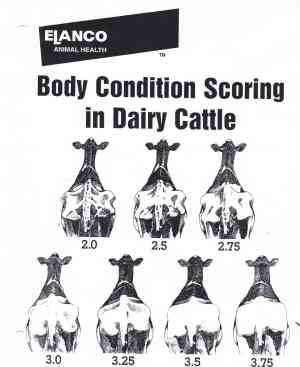
Once we were done with that, Profe Moro brought me into the milking parlor so I could judge the body condition score of the cattle. This scale goes from 1 to 5, 1 being severely emaciated and 5 being obese. you can use decimals as well such as 3.25,3.5, and 3.75. I used these charts to figure out where a cow belonged.


It's very subjective so you can be a little off and call a cow a 3.25 as long as it doesn't have a lot of traits that are from other numbers. I stood there as the people working in the milking parlor made cows  go through the pens in a line. I got to look that them up close and personal so I could judge them better. I did that for a few hours until all the cows were gone. It was very interesting to me. Profe Moro and I talked a little throughout the process to make sure I completely understood what I was doing. We usually had the same rating in mind and when we didn't agree I was only slightly off.

At the end of our time at the farm all the other students gathered around the break area. It was the 2nd years' last day on the farm and 4th year students had to stand up and explain their projects on the farm.

A forth year student explains his project on crops such as maize, sugar cane, and other cash crops.
It was cool to see all the hard work they put into their projects. They're going to stay on the farm for the rest of the year so that they can continue their projects. One guy's project is a grazing system, which I'll be helping with. One girl's project involved reducing mastitis in dairy cattle. I'm going to work with her wednesday in the milking parlor and then go with her to a lab to test dairy samples. It's really exciting!

I left around 11:05, took a shower, and relaxed. While I was working on this blog post I finally met my roommate Marcela for the first time! She's from Costa Rica and she's a third year student. She was in La Flor, EARTH's smaller sister campus on the pacific side, for a few weeks with all the other third year students. She's very nice!

For dinner there was chicken with peppers and onions and these yucca chips on the side. They use a lot of yucca down here! They use it as a healthier replacement for potatoes. They're really good and are much better than potato chips, I'm definitely going to make a batch when I get home! They probably won't be as good as the chips here though.

Since tomorrow's Sunday things are really going to calm down. I won't be on the farm, but I will be helping with another english class again and go swim with Lina after. It's weird to think that I'm already done with my first week at EARTH. It really flew by! 1 down 7 more to go!

Here are some other pictures I took this week.
The lobby of the library

Some agronomy books

The view from the library window

Spanish animal production books!

80 or so books about soil

More animal production stuff 
Even the plugs in the library are farm related!
A decorated ox yolk
Street art in San Jose
A huge sow says hello!
The little kitchen on the animal farm
A decorated cart in one of the campus pavillions
The view from my front door
The tree in front of the library
The W. K. Kellogg library
The plaque in front of the library

The staircase to the 2nd floor of the library


Have a good night guys!
-Allie